CRM Services
CRM discovery: design before you build
Most CRM and automation issues do not start with the tools. They start with unclear processes, undefined data, and assumptions about how the business actually works.
Flowbird helps you map your systems, data and workflows upfront, so what gets built is structured, intentional and aligned with how your business really operates.
Most systems are built too quickly. That is where problems begin
It is tempting to move straight into setup. But without proper discovery, systems are built on assumptions that do not hold up over time.
Without proper discovery
- Processes interpreted differently across teams
- Data structured inconsistently or duplicated
- Systems that reflect tools, not the business
- Constant rework as gaps become visible
Flowbird approach
- Clear mapping of how your business actually operates
- Defined data structure across systems
- Decisions made before anything is built
- A foundation that reduces rework later
What skipping it costs
A system built without discovery is not wrong on day one. It is wrong on the day the business does something the system was never told about, which is usually about four months in.
- The process it enforces is the one somebody described in a meeting, not the one the team actually follows, so the workarounds start immediately.
- The fields were chosen before anyone knew what would need reporting on, so the reports cannot be built without going back to the records.
- Nobody agreed what a customer is, so finance, sales and marketing each hold a different version and none of them reconciles.
- Every later change is a renegotiation, because there is no written record of why anything was set up the way it was.
What discovery finds in the data
Mapping how the business works surfaces the state of the records almost immediately. Two teams using one field to mean different things. A customer that exists three times. A lifecycle stage nobody can define the same way twice. An integration that has been quietly creating duplicates since a platform update nobody noticed.
None of that is a note for later. It is the reason the build would have failed, and it goes straight into the data programme as scoped work rather than turning up halfway through configuration.
- What a data audit should measure, and on which objects
- Which records need cleaning before anything is configured
- Which fields need enriching for the segments the business actually wants
- Which integrations are creating the mess rather than carrying it
Nothing gets built on records nobody has looked at. Where discovery turns up a data problem large enough to change the plan, we say so before the plan is signed rather than after.
Where discovery leads next
The workshop below is how the work is done. What it produces, and what usually follows it, is one of these.
CRM Readiness Audit
A structured assessment of whether you are ready to implement, migrate or redesign your CRM. You leave with a readiness report covering process clarity, data quality, reporting needs, automation risks and implementation priorities.
CRM and Data Blueprint
A target-state blueprint for how CRM, process, data, reporting and automation should fit together. Ideal for teams that have outgrown their setup or need to connect multiple systems with a phased implementation roadmap.
How we run discovery: the Event Storming workshop
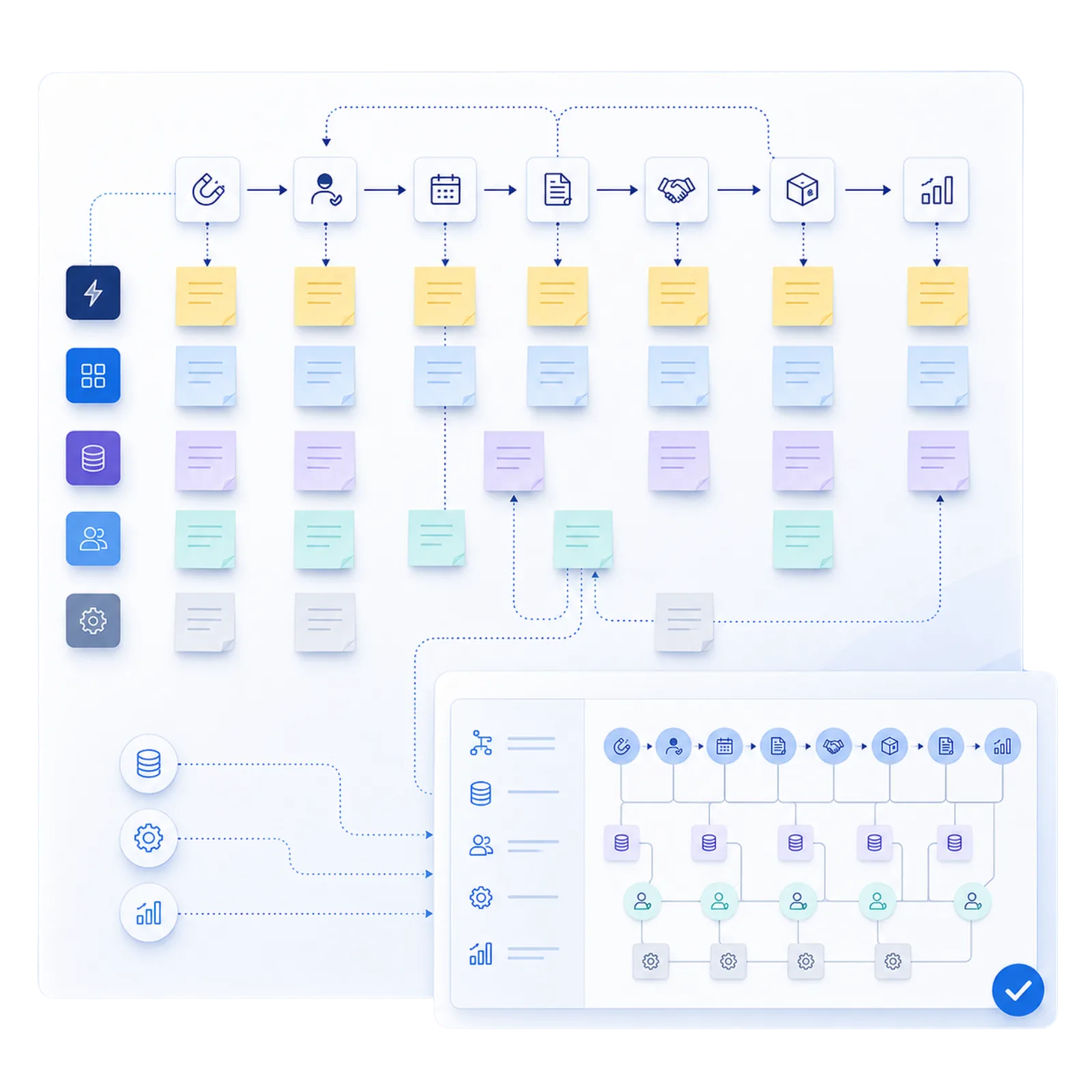
Map how your business actually works before CRM, automation or reporting decisions are made. Flowbird runs practical Event Storming workshops to surface key events, decisions, handoffs, risks and system requirements before anything is built.
Talk to us about Event Storming
No pressure. No hard sell. Just a practical conversation about whether this is the right starting point.
What it is
An Event Storming workshop is a collaborative session where your team maps the real events that happen across your business. Instead of starting with software fields, pipelines or automations, we start with how work actually moves: what triggers action, who makes decisions, where handoffs happen, what data is needed, and where the process breaks down.
For CRM and customer data projects, this gives everyone a shared view of what the system needs to support before design or implementation begins.
Useful when the business process is bigger than the system currently shows
Most teams do not ask for Event Storming by name. They usually arrive because something about their CRM, reporting, automation or handoffs feels harder than it should.
- Your CRM does not match reality. The system shows a process, but the team works around it.
- Different teams describe the process differently. Sales, marketing, operations and leadership all have slightly different versions of what happens.
- Automation feels risky. You know there are repeatable steps, but you are not confident enough in the process to automate them.
- Reporting cannot be trusted. The numbers are difficult to explain because the process and data structure underneath them are unclear.
- Handoffs keep breaking. Important context gets lost between people, teams or systems.
- You are about to rebuild or migrate. You want to avoid carrying old confusion, and old data, into a new CRM.
A focused working session, not a generic discovery call
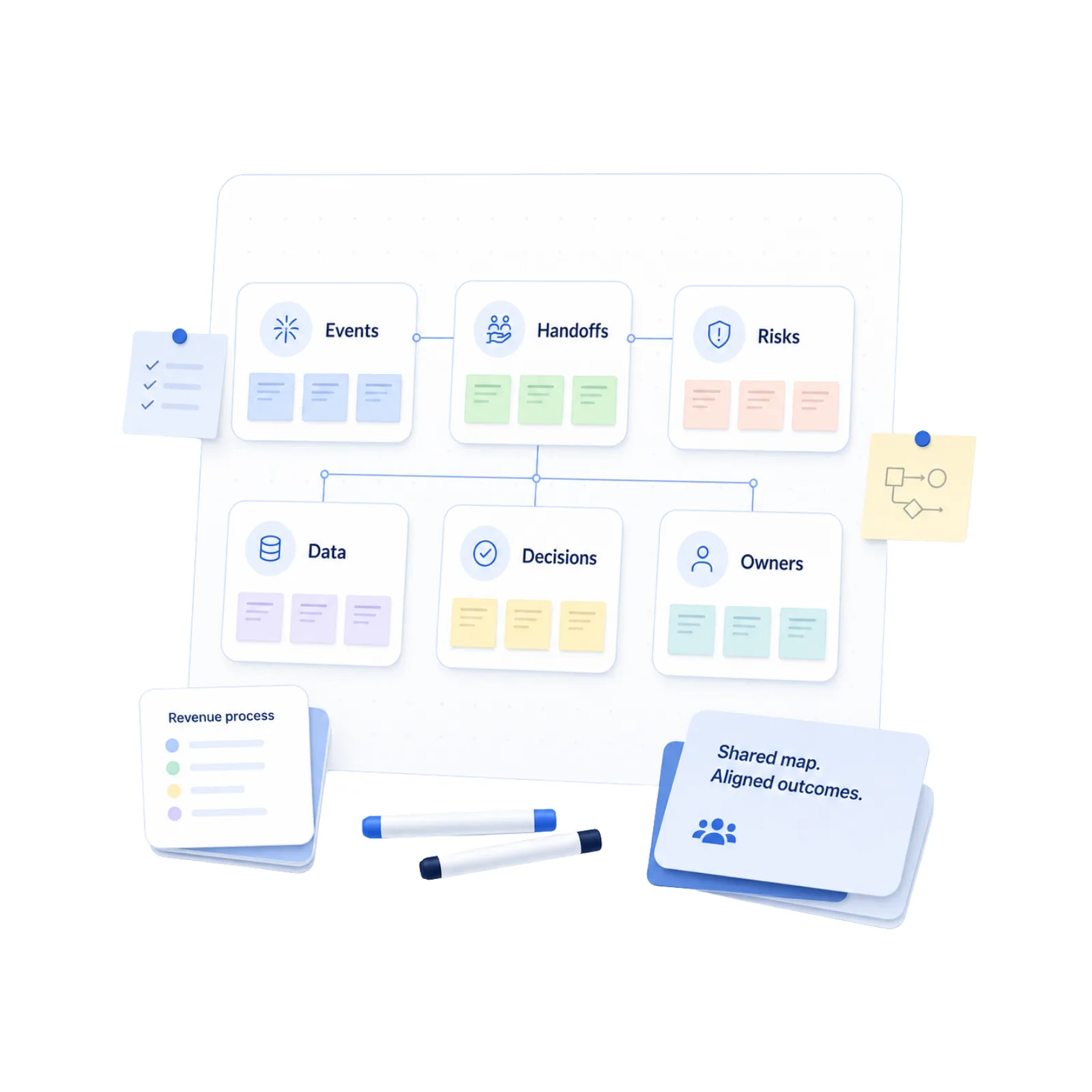
The workshop is designed to get the right people in the room and turn scattered process knowledge into a clear, shared map. It can be run remotely or in person, depending on the complexity of the project and the people involved.
- Format: a collaborative mapping session led by Flowbird.
- Location: remote, on-site, or hybrid.
- Duration: usually half a day or a full day, depending on scope.
- Who attends: people who understand sales, operations, data, reporting, customer handoffs and management decisions.
- Best for: CRM builds, rebuilds, migrations, automation projects, reporting improvement and wider system design.
- Typical next step: CRM Readiness Audit, CRM and Data Blueprint, CRM implementation, automation scoping or reporting design.
We map the business before designing the system
Define the business area
We agree the part of the business we are mapping, such as lead management, sales pipeline, onboarding, delivery handoff, reporting, customer lifecycle or a wider revenue process.
Capture key events
We identify the important things that happen across the journey: enquiries, qualification moments, decisions, status changes, approvals, handoffs, customer updates and internal triggers.
Surface decisions and ownership
We clarify who makes decisions, who needs to act, who owns each step, and where responsibility becomes unclear.
Identify data and system needs
We map what information is needed at each point, where it should live, how it should move, and which systems need to be involved.
Highlight gaps, risks and priorities
We identify friction, duplication, reporting weaknesses, automation risks and the areas that need further design before implementation begins.
What you leave with
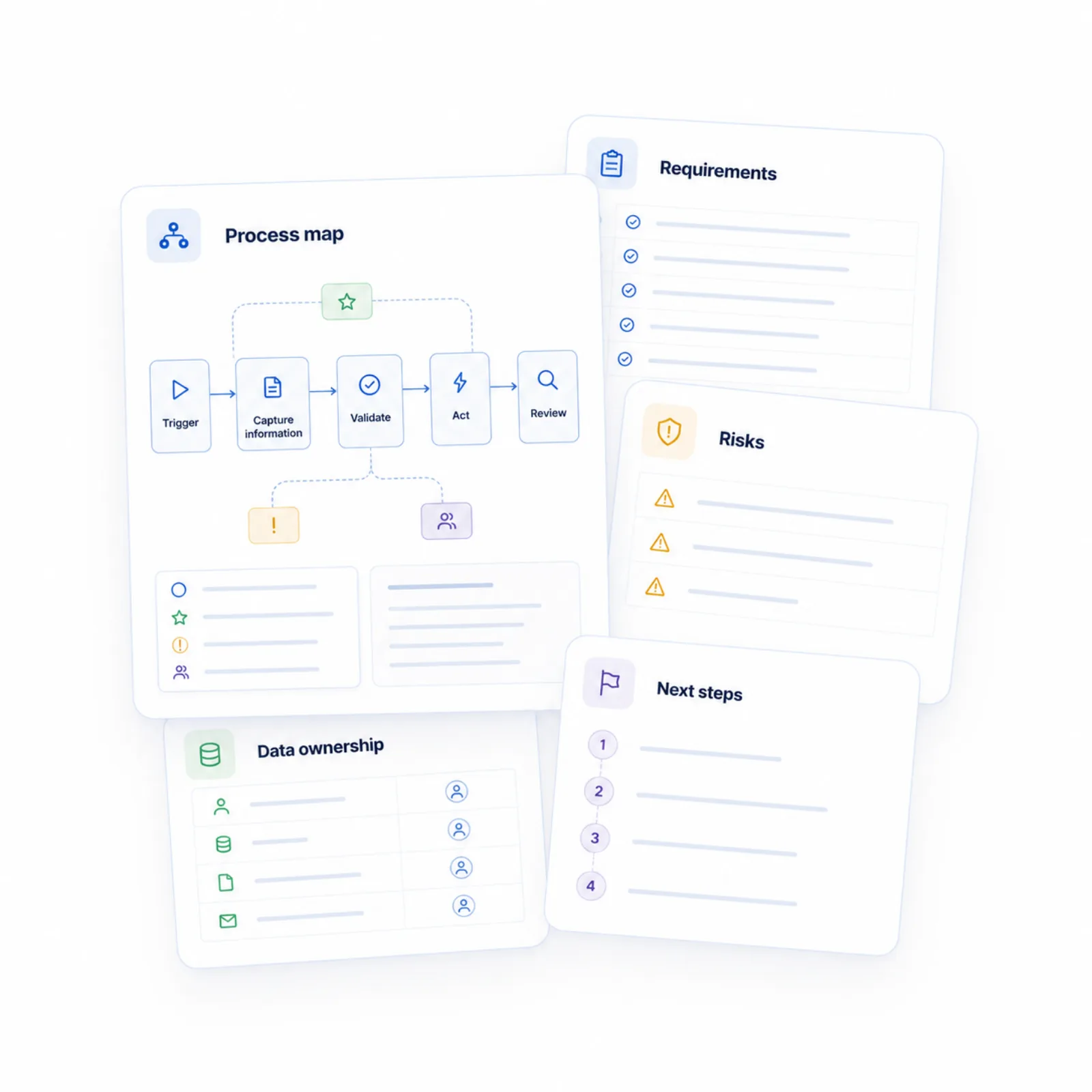
The value of the workshop is not just the conversation. The aim is to create practical outputs that help your team make better decisions about CRM, automation, reporting and implementation.
A shared process map
A clear view of the key events, decisions, handoffs and exceptions that shape how work actually moves through the business.
A list of system requirements
A practical summary of what the CRM, and the data feeding it, need to support.
Identified gaps and risks
A clearer view of where the process is unclear, duplicated, fragile or dependent on manual work.
Data and ownership considerations
An outline of what data is needed, where it belongs, who owns it and where it needs to move.
Recommended next steps
A suggested route forward, which may include a readiness audit, blueprint, CRM build, automation scoping or reporting project.
The best workshops include the people who know what really happens
Event Storming works best when the session includes people who understand the process from different angles. That does not mean everyone in the business needs to attend. It means the right mix of people should be represented.
- Leadership, to clarify priorities, commercial goals and decision-making needs.
- Sales or customer-facing teams, to explain how opportunities, customers and conversations actually move.
- Operations or delivery, to map handoffs, fulfilment, service delivery and internal dependencies.
- Marketing or lead generation, to explain where demand starts and how leads enter the system.
- Finance or admin, to identify billing, approval, compliance, data and reporting requirements.
- Internal system owners, to explain current tools, constraints, workarounds and technical dependencies.
A strong starting point before design, build or automation work
An Event Storming Workshop is often used at the start of a wider CRM or customer data project. It gives the team enough shared understanding to make better decisions about structure, data, reporting, automation and implementation.
- Before a CRM implementation, to define how the system should support real processes before configuration begins.
- Before automation or integration work, to identify which handoffs and triggers are reliable enough to automate.
- Before reporting improvement, to understand whether the data and process beneath the reports are strong enough to trust.
- Before a system blueprint, to give a more detailed CRM and Data Blueprint its discovery foundation.
When this is, and is not, the right starting point
This is a good fit if you need to understand how work actually moves before changing your CRM, automations, reporting or wider system structure.
Good fit if
- your team has different views of the same process
- you are preparing for a CRM build, rebuild or migration
- you want to reduce risk before automation
- you need leadership and delivery teams aligned before implementation
- your current system has grown around workarounds
Not the right fit if
- you only need a quick software demo
- the process is already fully documented and agreed
- you are looking for basic user training only
- you need emergency troubleshooting rather than structured discovery
- you want to skip straight into configuration without clarifying the business process
Not sure if this is the right offer? We will help you choose the most useful starting point. Talk to us about Event Storming.
Questions people ask before starting
We already know our processes. Do we need this?
Often what is known is the intended process rather than the one being followed, and the gap between them is where systems fail. Discovery is usually short when a business genuinely has this straight, and finding that out quickly is a good outcome.
Can we not just start building and adjust as we go?
You can, and for a small system it is sometimes right. It stops being right when more than one team depends on the same records, because by then a change to the structure is a change to everyone's work.
How is this different from a [CRM data audit](/crm-data-audit)?
An audit measures the data you have. Discovery decides what the system should be. If you are choosing or rebuilding a CRM you want discovery. If reports are wrong in a system you are keeping, you want the audit.
Do we need this before choosing a platform?
It is the cheapest time to do it. Choosing a CRM before knowing what it has to do is how businesses end up paying for capability they never use and building around the capability they needed and did not check for.
What if discovery says we do not need a new system?
Then that is what it says, and it will have cost you a workshop rather than an implementation. That answer comes up more often than the software industry finds convenient.
Discovery is the cheapest part of the project
It is also the one most often cut, because it produces a document rather than a system and it happens before anyone is impatient. The businesses that skip it do not save the money. They spend it later, on rework, on a second implementation, or on a system the team quietly stopped using.
What you leave with is a written design: the process as it actually runs, the data model, who owns which record, and what the system has to do before anyone configures anything. It is the thing every later decision gets checked against, including ours.